🌿 Welcome to Herb's Guide to Herb 
📚 Knowledge grows higher here 

Welcome! Pull up a chair, get comfortable, and stay awhile.
Herb's Guide to Herb is an educational cannabis knowledge base created for people who want to better understand cannabis — especially those exploring cannabis for medical or therapeutic purposes.
Cannabis can be surprisingly complicated. There's THC and CBD, of course, but then you start hearing about CBG, CBN, CBC, THCV, terpenes, indica, sativa, hybrids, ratios, concentrates, tinctures, flower, different consumption methods... and suddenly a simple plant has turned into an entire subject to study.
That's where Herb comes in. 🌱
Our goal is to make cannabis information approachable, useful, and easy to understand without stripping away the science and details that actually matter.
Whether you're completely new to cannabis, helping someone else understand their options, or already know your myrcene from your limonene, you're welcome here.
📖 What Is Herb's Guide to Herb? 
Think of Herb's Guide to Herb as a friendly cannabis field guide with a particular focus on education, wellness, and medical use.
We're interested in understanding why different cannabis products may feel different, what compounds are present in the plant, what current evidence tells us, and what information may be useful when discussing cannabis with a qualified healthcare professional.
Throughout the guide, you'll find information about topics such as:
- 🌱 Cannabis strains and their commonly reported characteristics
- 🧬 Cannabinoids such as THC, CBD, CBG, CBN, CBC, THCV, and others
- 🍋 Terpenes, including their aromas, natural sources, and researched properties
- 🧠 Commonly reported effects and experiences
- 🩺 Medical and therapeutic research involving cannabis and its compounds
- 💨 Consumption methods and how they differ
- 🧪 Potency, cannabinoid percentages, ratios, and product labels
- ⚖️ Potential benefits, risks, side effects, and interactions
- 📚 Cannabis terminology and basic science
- 🔬 The research behind what we currently know — and what we don't know yet
The goal isn't to tell you what you should use.
It's to help you better understand what you're looking at.
🌿 We're Not Trying to Be Leafly 
There are already excellent resources for browsing enormous strain databases, checking dispensary menus, reading thousands of user reviews, and discovering what's popular.
That's not really what we're building here.
Herb's Guide to Herb is intentionally more focused.
We don't intend to catalog every strain ever created, and the absence of a strain from this guide doesn't mean there's anything wrong with it.
Instead, our strain library focuses on strains and products for which we can provide information that may be useful to someone approaching cannabis from a medical, therapeutic, or wellness perspective.
When discussing a strain, we're interested in more than whether somebody thought it was "🔥🔥🔥."
We want to look at things like:
What cannabinoids are commonly present? What terpenes tend to dominate? What effects are commonly reported? Are there unwanted effects worth knowing about? What might explain those effects? How much can the chemistry vary between growers or batches? And what does the available evidence actually support?
That's the kind of rabbit hole Herb likes to wander down.
🧬 There's More to Cannabis Than THC 
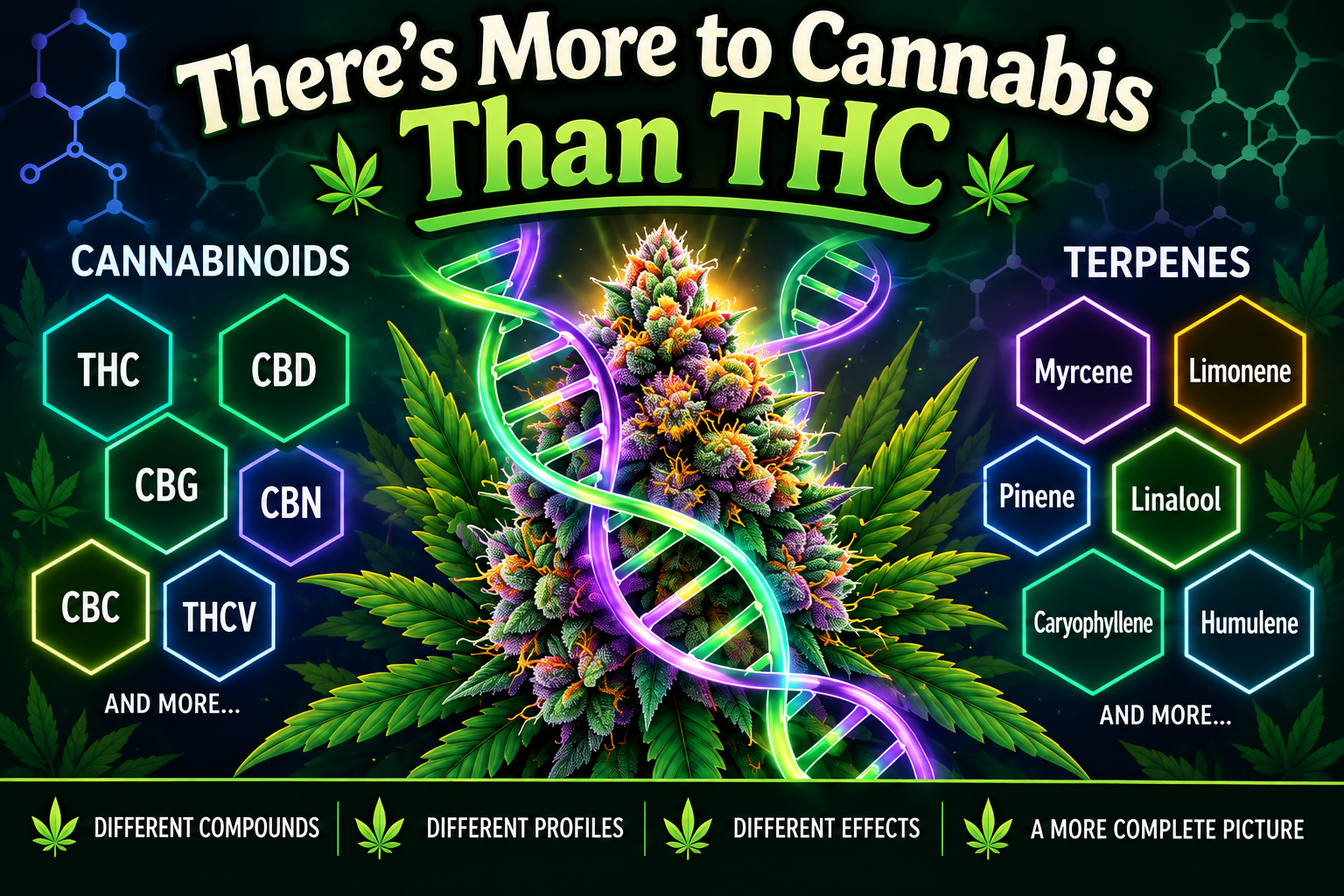
One of the biggest ideas behind this guide is that cannabis shouldn't necessarily be understood by looking at THC percentage alone.
Cannabis contains a complex mixture of cannabinoids, terpenes, flavonoids, and other compounds. Two products with similar THC percentages can have very different chemical profiles — and people can have very different experiences with them.
That's why you'll see us talk about things like:
THC • CBD • CBG • CBN • CBC • THCV • Terpenes • Ratios • Potency • Method of Consumption
Understanding those pieces can give you a much better vocabulary for describing what works for you, what doesn't, and what you'd like to discuss with your healthcare provider.
It can also help turn:
"That weed made me feel better."
into something more useful, like:
"This product had this cannabinoid and terpene profile, I used this amount, and these were the effects I noticed."
That kind of information can be much more valuable when you're trying to understand your own experience.
🩺 Medical Information — Not Medical Advice 
Please Read This
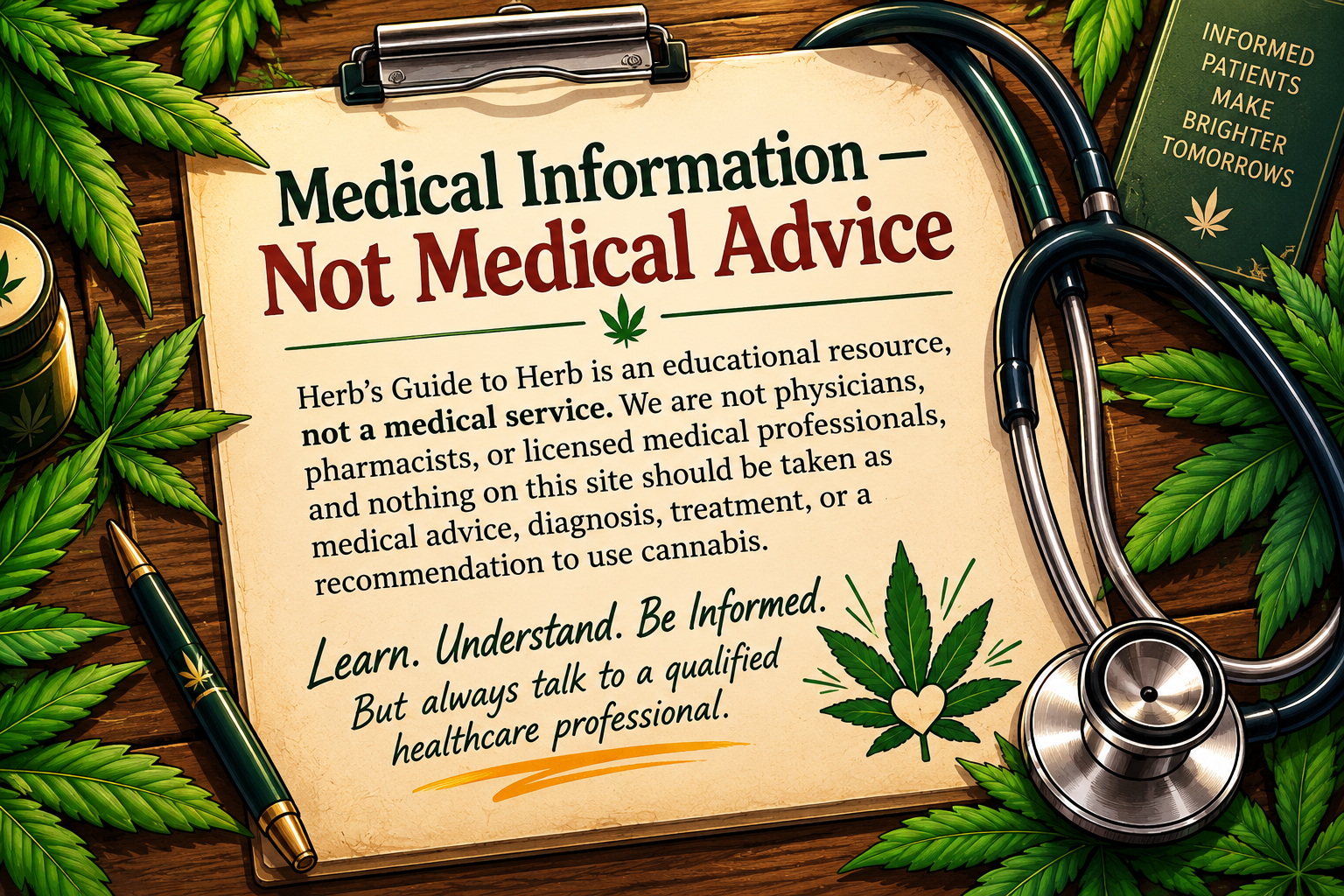
Herb's Guide to Herb is an educational resource, not a medical service.
The people creating and maintaining this site are not physicians, pharmacists, or licensed medical professionals, and nothing published here should be interpreted as medical advice, diagnosis, treatment, or a recommendation to use cannabis.
Cannabis affects different people differently.
A product that works wonderfully for one person may be ineffective or unpleasant for another. Cannabis can also cause side effects and may interact with medications, medical conditions, anesthesia, alcohol, and other substances.
Information about a cannabinoid, terpene, strain, or product having a potential therapeutic property does not mean that it has been proven to treat a particular medical condition or that it is appropriate for you.
Research surrounding cannabis is also continually developing. Some proposed benefits have substantial evidence behind them, while others are supported only by limited research, preliminary studies, or anecdotal reports.
We believe that distinction matters.
When possible, this guide tries to distinguish between:
- Established evidence
- Emerging or limited research
- Commonly reported effects
- Traditional or anecdotal claims
- Things we simply don't know yet
"We don't know yet" is a perfectly good scientific answer.
🗣️ Talk to Your Doctor 
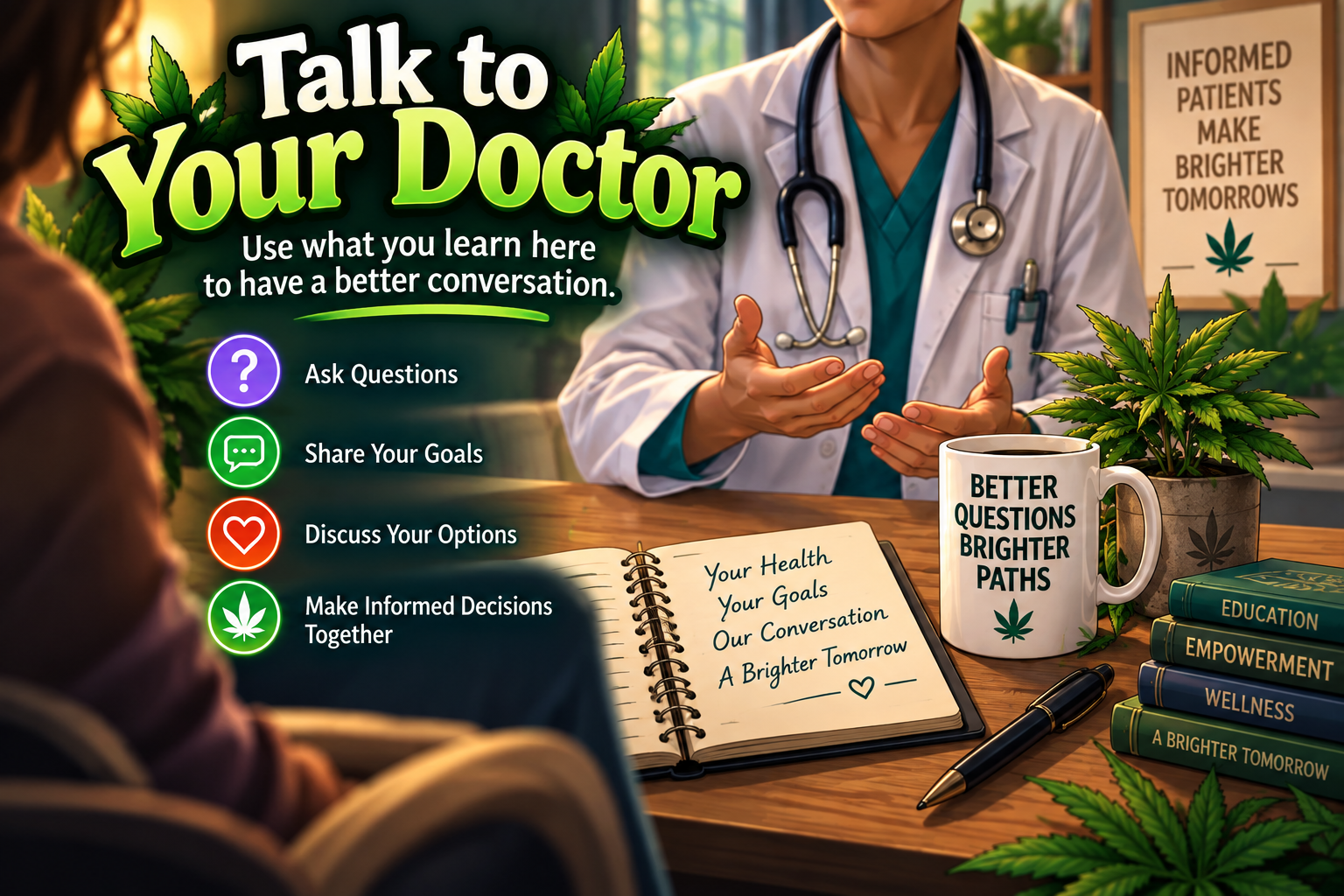
If you're considering cannabis for a medical condition or symptom, talk with your doctor or another appropriately qualified healthcare professional.
Yes, even if cannabis isn't something you've discussed with them before.
Being open with your healthcare provider gives them an opportunity to consider things this website simply cannot — including your medical history, current medications, diagnoses, allergies, risk factors, and other treatments.
You don't need to walk into that conversation already knowing everything.
That's actually one of the reasons this guide exists.
Use the information here to learn the vocabulary, understand the basics, explore the research, and develop better questions.
Maybe you discover that you'd like to ask your doctor:
"Could CBD interact with any of my medications?"
Or:
"I've noticed products high in a particular terpene seem to affect me differently. Is there a reason that might happen?"
Or simply:
"I'm considering medical cannabis. Can we talk about whether it makes sense for me?"
Knowledge shouldn't replace that conversation — it should help you have a better one.
🧠 Learn. Observe. Ask Questions. 
If you choose to use cannabis legally and with appropriate medical guidance, one of the most useful things you can do is pay attention to your own experience.
The name printed on a jar isn't the whole story.
Consider the cannabinoid percentages. Look at the terpene profile when it's available. Pay attention to the amount you consumed, how you consumed it, how long the effects took to appear, how long they lasted, and how you actually felt.
Notice both the good and the bad.
Did something help with the reason you were using it?
Did it make you sleepy?
Hungry?
Relaxed?
Focused?
Uncomfortable?
Anxious?
Did a smaller amount work better than a larger one?
Those observations can help you recognize patterns over time and give you better information to discuss with your healthcare provider.
🔬 Cannabis Science Is Still Growing 
Cannabis research has expanded enormously, but there's still a great deal we don't fully understand.
You'll sometimes encounter very confident claims online about exactly what a particular terpene, cannabinoid, or strain will do.
Reality is usually more complicated.
Individual biology, tolerance, dosage, cannabinoid ratios, terpene profiles, method of consumption, medications, environment, and many other variables can influence someone's experience.
Even two batches sold under the same strain name may not have identical chemical profiles.
For that reason, Herb's Guide to Herb tries to avoid treating strain names like prescriptions.
Instead of:
"This strain treats anxiety."
we'd rather explore:
"These compounds are commonly found in this strain, these effects have been reported, this is what research currently suggests, and these are the limitations of what we know."
It's a little less flashy.
But it's a lot more useful.
💚 Who Is This Guide For? 
Herb's Guide to Herb is for the curious.
It's for the new medical cannabis patient staring at a dispensary menu wondering what half the words mean.
It's for someone trying to understand why one product worked well while another absolutely did not.
It's for people who want to learn what those tiny percentages on a product label actually represent.
It's for caregivers, partners, friends, and family members trying to better understand cannabis.
It's for experienced consumers who want to dig deeper into the science behind the plant.
And it's for anyone who believes cannabis education can be responsible without being boring.
You don't need to be an expert.
You just need to be willing to learn.
🌱 Start Exploring 
There's a lot growing around here.
Browse the guide, follow whatever catches your interest, and don't worry if you end up ten pages away from where you started.
That's half the fun of a wiki.
Start with a strain.
Follow one of its terpenes.
Discover a cannabinoid you've never heard of.
Learn how different consumption methods affect onset and duration.
Read about something you thought you understood and discover there's more to the story.
Then take what you've learned and use it to ask better questions — of your doctor, your pharmacist, knowledgeable cannabis professionals, and yourself.
🌿 One Last Thing From Herb 
Cannabis doesn't need more exaggerated promises.
It needs better information, better conversations, responsible use, and people who aren't afraid to say when the science hasn't given us an answer yet.
That's what we're trying to cultivate here.
So explore. Be curious. Read the research. Keep track of your experiences. Ask questions. Talk to your healthcare provider.
And hopefully, somewhere along the way, you'll gain the knowledge and confidence you need to better understand cannabis and find the products that work best for you.
Welcome to Herb's Guide to Herb. 💚
~ Stay curious. Stay informed. And keep growing.